

Ancient Witnesses

Living Memory

When the Sycamore Gap tree was felled beside Hadrian’s Wall, the public reaction was immediate and deeply emotional. People were shocked, angry and genuinely bereaved. It was not simply because a tree had been destroyed. It was because a familiar presence had vanished from one of the most recognisable landscapes in Britain.
The gap was still there.
The wall was still there.
The hills were still there.
But something that had helped people feel the place had gone.
Now, with the reported death of the Major Oak in Sherwood Forest, that same feeling returns in a different form.
The Major Oak was not cut down in a single act of violence. Its ending appears to have come slowly, after centuries of survival and years of visible decline. Yet the sense of loss is just as powerful.
For generations, it stood as one of Britain’s great living landmarks: ancient, rooted, weathered, and inseparable from the legend of Robin Hood. Two trees. Two very different losses. But one shared truth. Some places are held together by living things. A tree can become more than a tree. It can become a signpost, a witness, a meeting place, a memory point, a symbol of home. It can hold childhood visits, family photographs, school trips, local pride, folklore, tourism, film imagery, national identity and private grief. It can stand quietly for decades or centuries while people come and go beneath it.
That is why these losses matter.
The Sycamore Gap tree was not ancient in the same way as the Major Oak, but age alone is not what gives a place meaning.
Its power came from its position in the landscape: a lone tree held in a dip beside Hadrian’s Wall, simple and unforgettable. It framed the land around it. It gave the eye somewhere to rest. It turned a stretch of history into an image people carried with them.
The Major Oak carried a different kind of weight. It was older, mythic, and bound to the stories of Sherwood Forest. Whether Robin Hood ever hid there is less important than the fact that people believed the tree brought the legend closer. It made the story touchable. It gave folklore roots.
That phrase matters: roots. Because stories need roots.
They can survive in books, archives, museums and films, but they gather strength when they remain connected to physical places.
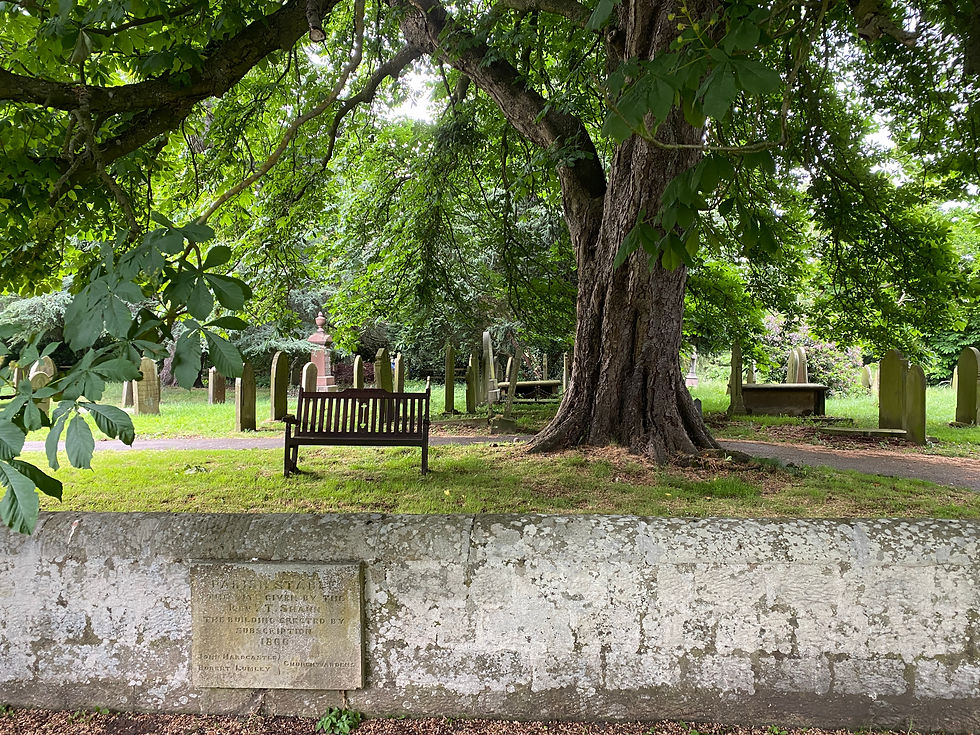
A tree. A chapel. A moor. A road. A ruin. A valley. A stone rescued from a vanished church.
These things allow the past to exist not only as information, but as experience.
You can stand there.
You can feel the weather.
You can look across the same land.
You can understand, even briefly, that history did not happen somewhere else.
It happened here.
That is why heritage cannot be treated only as buildings, documents and objects behind glass. Museums and archives are essential. They protect what might otherwise disappear. But there is another kind of archive outside: in trees, paths, rivers, fields, churchyards, ruins, moorland and village names.
The land itself holds memory.
Sometimes it does so quietly for so long that we stop noticing until something is lost.
Then suddenly everyone notices.
The danger is that we only understand the value of these places after they have gone.
Yorkshire has its own oak memories too.

The Cowthorpe Oak, once regarded as one of the great trees of England, was renowned for its extraordinary age and size. It was sketched by J. M. W. Turner, written about by antiquarians, photographed in its later years, and celebrated as one of the wonders of Yorkshire. At its greatest extent, its canopy was said to cover half an acre of land. Its hollow trunk was large enough, according to local accounts, to hold dozens of people.
The tree fell in 1950, but its story did not disappear.
It survived in drawings, photographs, local writing and descendants grown from its acorns. Some of those acorns travelled as far as New Zealand, where the tree’s lineage continued. That is a remarkable thought: a Yorkshire oak, gone from its own landscape, still living on through memory, record and growth elsewhere.

Closer to Nidderdale, Ripley Castle’s deer park still contains ancient and veteran trees that connect the present landscape to the old wooded world of the Forest of Knaresborough. Some of its oaks are believed to be over a thousand years old. They remind us that the history of a place is not only preserved in buildings, documents or family names, but in living things that have endured across centuries of change.

At John of Gaunt’s Castle, ancient oaks still stand quietly in the landscape.
They are not famous like the Major Oak, and not instantly recognisable like the Sycamore Gap tree. They may never appear on national news. Yet for those who know the place, they have their own power.
They stand as witnesses.
They belong to the memory of that place.
They remind us that not every significant tree becomes nationally famous. Some simply remain, holding the stories of a landscape for those who know where to look.
Film has a role to play in that.
A film cannot replace a felled tree, a dead oak, a flooded village, a lost church or a ruined building. But it can preserve emotional access. It can hold atmosphere. It can capture the relationship between people and place. It can make audiences look again at landscapes they thought they already knew.
At its best, film can become a bridge between what was, what remains and what might still be protected.
So perhaps the question is not only what we have lost, but what still stands quietly around us.
What is your tree?
Where does your story rest?


Comments